|
|
 |
|
|
 |
|
|
|
|
|
|
 |
|
|
|
|
|
|
|
At
Flatout Gaskets customer needs come first
We believe one-on-one customer service and technical
support is extremely important. Our goal is to give
customers the right gaskets, when they want them, all
at a fair price. Flatout has experienced staff ready
to answer questions, take orders and prepare quotes
for special applications. Flatout Gaskets are designed
to meet the needs of the application, as such we use
the best, most cost effective base materials, coatings
and sealing aids. |
|
|
|
|
|
|
|
|
|
|
|
|
|
|
|
|
|
 |
|
|
|
|
|
|
|
With all the available
cylinder head and block combinations today, occasionally the builder
may run into a misalignment issue when mounting their intake manifold.
Flatout Gaskets offers billet aluminum intake manifold spacer kits for
all V-8 and V-6 engines. These billet spacer kits are available with
either a .125" or .250" thick aluminum spacers. The kit also includes
(2) Flatout .060" thick intake gasket sets for either side of the
spacer.
Head gasket shims are offered for EVERY head gasket available in the
Flatout lineup. When head or block machining is beyond the normal
"cleanup" it may be necessary to adjust the thickness at the head
gasket joint using a shim. We rubber coat the shim on both sides to
seal fluids. And the rubber coating is compatible with every type of
combustion seal. Thicknesses available range from .020" to .125" in
approximately .010" increments.
Custom or modified shims and spacers are available from Flatout
Gaskets, usually at the same price as our standards kits. Please email
or call to inquire about any spacer or shim question. |
|
|
|
|
|
|
|
 |
|
|
|
|
|
|
|
 |
|
|
|
|
|
|
|
|
|
|
|
 |
|
|
|
|
|
|
|
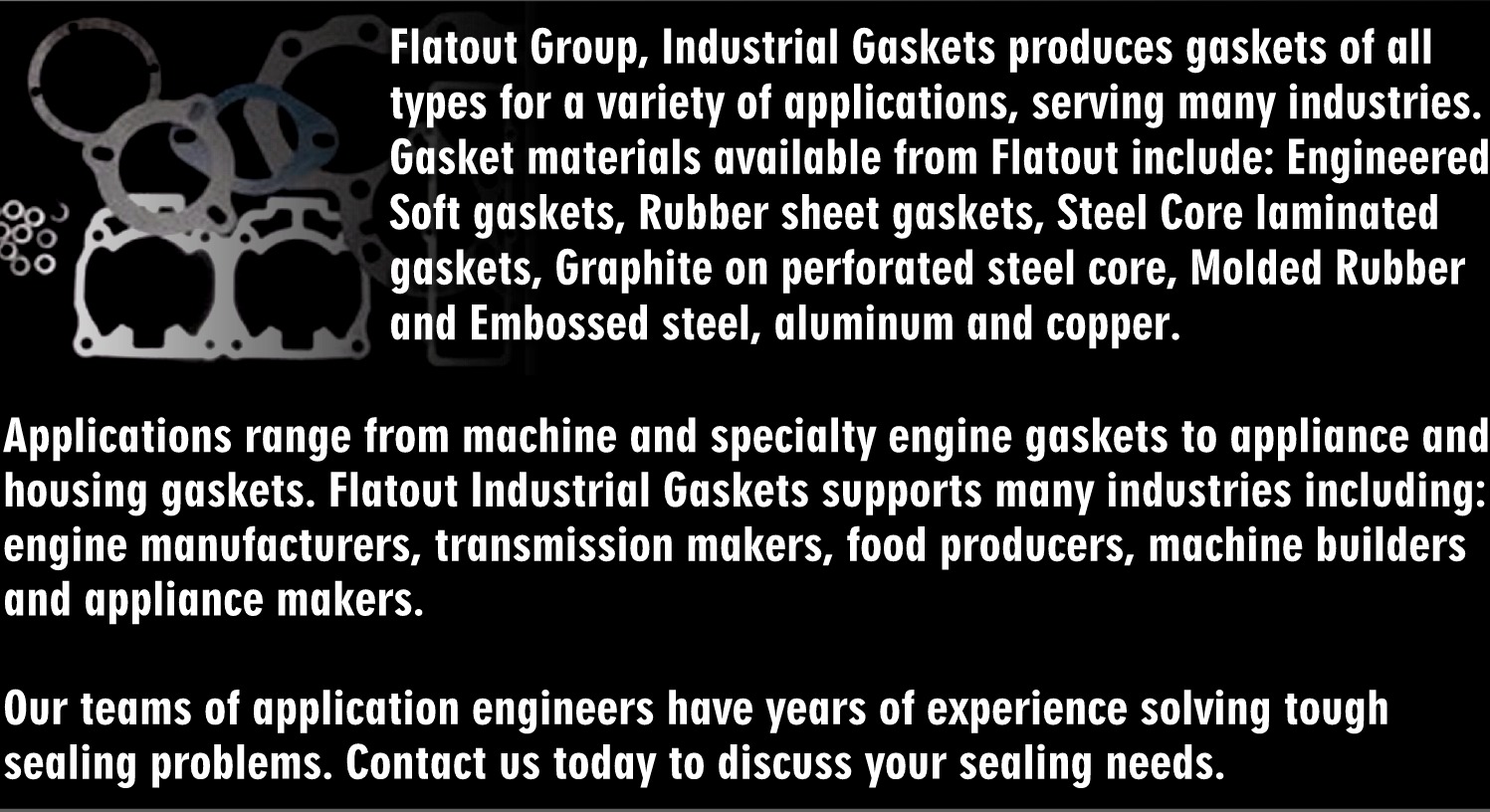
Engineered Gasket Materials
Soft gasket materials are those that compress easily
in a typically joint environment. Soft gasket can be
made from a variety of base materials, binders and
reinforcing fibers. Base materials are typically
inorganic clays and fillers. Common binders are
synthetic rubber such as Nitrile, Neoprene, SBR, EPDM
and Vitron. Non-Asbestos fibers used today are most
commonly cellulose and arimad.
Soft gaskets are made using two common methods: a wet,
paper making type process which produces a wide
variety of materials with many colors, densities and
performances characteristics. Materials come in sheet
or roll form. Compressed sheet gaskets are higher
density for tougher applications. Material coming in
sheet form.
Solid
Rubber Gasket Materials
Natural Rubber
Natural rubber has good resistance to mild acids and
alkalizes and chlorine solutions. Natural rubber is
poor in oils and solvents. Temperature range: -65 to
210 F.
SBR
(Styrene-Butadiene)
SBR has excellent abrasion resistance and has good
resistance to alcohols, and ketones, It is not
suitable for strong acids, ozone, oil and fuels.
Temperature range: -65 to 260 F.
Neoprene
(Chloroprene)
Neoprene has good resistance to oils and fuels and has
poor resistance to chlorinated hydrocarbons and acids.
Temperature range: -65 to 250 F.
Nitrile,
NBR Rubber (Buna-N)
Nitrile has good resistance to oils and solvents. It
has good resistance to caustics and salts. It has poor
resistance to in strong oxidizing agents, acids and
chlorinated hydrocarbons. Temperature range:-65 to 270
F.
EPDM
(Ethylene Propylene-Diene Monomer)
EPDM has good resistance to acids, alkalizes, and
chlorine solutions. It is not recommended for use in
oils, solvents or fuels. Temperature range: -70 and
365 F.SiliconesSilicone rubber has good resistance to
hot air and not is affected by sunlight or ozone.
Silicone is not recommended for use in water, steam,
and aliphatic or aromatic hydrocarbons. Temperature
range: -65 to 500 F.
Fluorocarbon (Viton)
Fluorocarbon has good resistance to oils, fuels,
chlorinated solvents, hydrocarbons and strong acids
and has poor resistance to steam, amines and ketones.
Temperature range: -20 to 430 F.
Graphite
on Perforated Core (GPC)
This material is best suited for sealing exhaust gas
from engines, furnaces and other high heat
applications. The soft graphite sheet, physically
bonded to the top and bottom surfaces, provides
excellent sealing of fluids and gases. The steel core
provides exceptional stability of the gasket during
installation and excellent blowout resistance while in
the sealing application. Available thicknesses are
.045", .065" and .090". Temperature range: -60 to 1800
F.
Rubber
Coated Copper (RCC)
RCC is best used in very high clamp load environments
with solid flanges. The base material offer excellent
dimensional control, lateral strength and load
retention. The high temperature rubber coating is
.0015"/.0025" thick and provide an excellent coolant,
oil, and air seal. Temperature range: -60 to 600 F.
Solid
Core Laminate (SC)
Flatout Solid Core gasket materials are made today's
best engineered gasket materials, laminated to a solid
steel or aluminum core. The adhesive bond is
chemically resistant to solvents, oils and water based
solutions. SC gasket materials are used when lateral
strength is important for long-term sealing integrity
or when the gasket requires some rigidity for handling
and installation. For enhanced gasket sealability, SC
gasket materials can be tailored with an embossed to
increase the local sealing. |
|
|
|
|
|
|
|
|
|
|
|
|
|
|
|
|
|
|
|
|
|